 Hip & Ankle Mobility That Makes Your Murph Squats Smoother
If your Murph squats start strong but turn stiff halfway through, the problem isn’t your strength — it’s your mobility. Tight hips and ankles limit your squat depth, slow your rhythm, and make every rep feel like a grind. When you unlock mobility, your squats become smoother, faster, and more efficient — exactly what you need to crush all 300 reps in Murph without burning out. This guide breaks down how hip and ankle mobility that makes your Murph squats smoother will directly impact your Murph squat performance, plus the best drills to loosen up and move like an elite athlete.
🦵 Why Mobility Is the Hidden Key to Murph Squat Efficiency
Murph demands 300 air squats, often after hundreds of push‑ups and pull‑ups. That’s a massive endurance challenge — and mobility determines how well your body handles it.
When your hips and ankles move freely:
- You hit full depth without strain.
- Your knees track properly over your toes.
- You maintain balance and speed through fatigue.
- You recover faster between sets.
But when mobility is restricted, your body compensates — knees cave in, heels lift, and your lower back takes the hit. Over time, that inefficiency costs you reps and increases soreness.
🔍 The Anatomy of a Smooth Murph Squat
A perfect Murph squat combines strength, stability, and mobility. Here’s how each joint contributes:
- Hips: Control depth and power. Tight hip flexors or glutes limit range and cause forward lean.
- Ankles: Anchor your balance. Limited dorsiflexion (the ability to flex your ankle upward) forces your heels off the ground.
- Core: Stabilizes your torso so your legs can move freely.
- Knees: Act as the hinge between hip and ankle mobility — they follow the path those joints allow.
When hips and ankles move well, everything else falls into place.
🧘♂️ The Best Hip Mobility Drills for Murph Squats
These drills open your hips so you can drop deeper and move smoother through every rep.
1. 90/90 Hip Rotations
Sit on the floor with one leg bent in front (90°) and the other behind (90°). Rotate slowly from side to side.
Why it works:
Improves internal and external rotation — crucial for keeping knees aligned during squats.
Do: 2 sets of 10 reps per side.
2. Couch Stretch
Place one knee on the ground and your back foot against a wall or bench. Keep your torso upright and squeeze your glutes.
Why it works:
Opens tight hip flexors and quads, helping you maintain upright posture during squats.
Hold: 30–60 seconds per side.
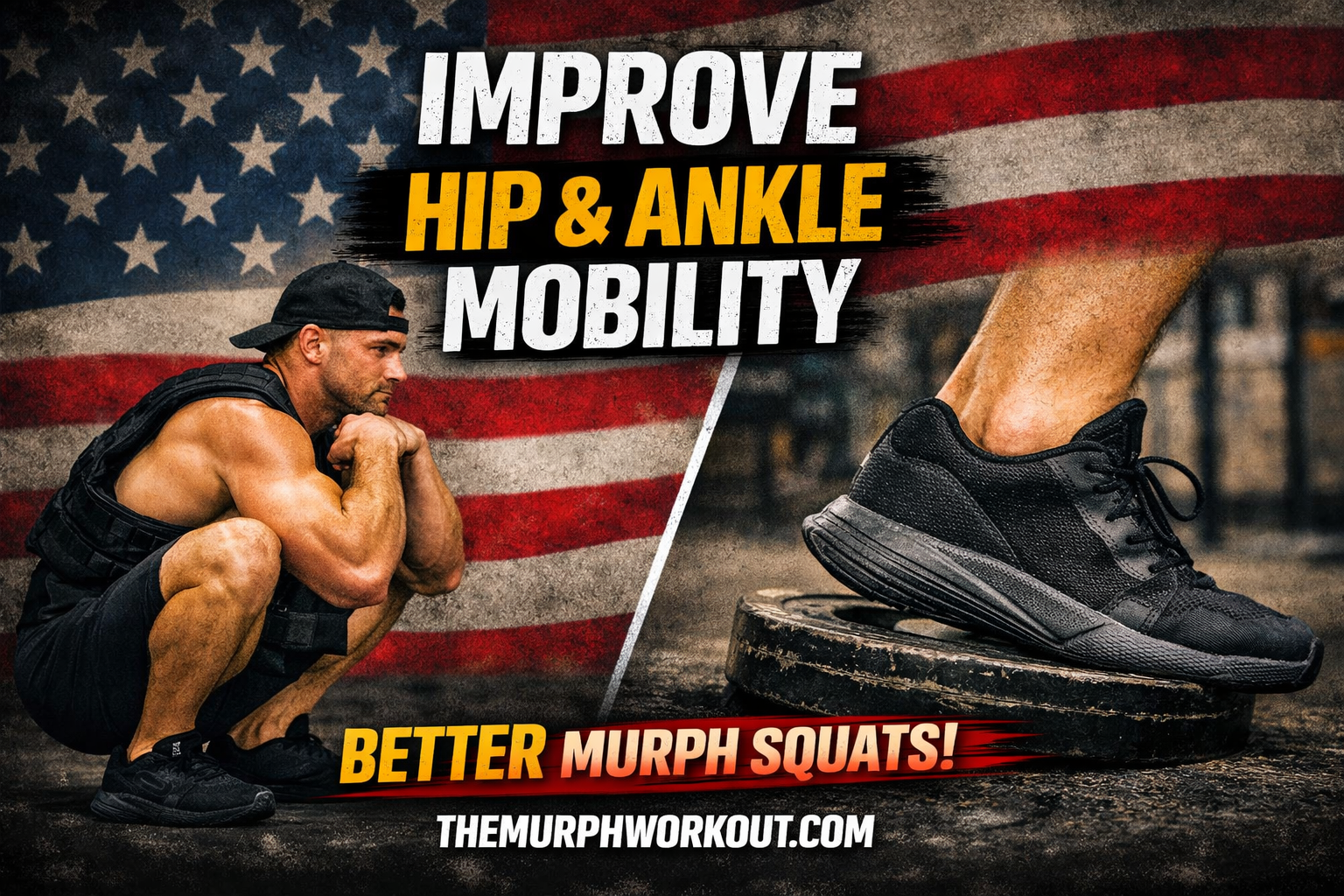
3. Deep Squat Hold
Drop into a full squat, elbows inside knees, chest tall. Rock gently side to side.
Why it works:
Activates hip flexors and adductors while improving bottom‑position comfort.
Hold: 60 seconds daily.
🦶 The Best Ankle Mobility Drills for Murph Squats
Your ankles are the foundation of every squat. These drills restore range and stability.
1. Knee‑to‑Wall Dorsiflexion
Stand facing a wall, one foot a few inches away. Drive your knee forward until it touches the wall without lifting your heel.
Why it works:
Improves dorsiflexion, allowing deeper squats with heels flat.
Do: 2 sets of 10 reps per side.
2. Heel‑Elevated Squats
Perform slow squats with heels on small plates.
Why it works:
Encourages ankle mobility while reinforcing proper knee tracking.
Do: 3 sets of 10 reps.
3. Calf Smash with Lacrosse Ball
Sit down, place a lacrosse ball under your calf, and roll slowly to release tension.
Why it works:
Loosens tight calves that restrict ankle movement.
Do: 1–2 minutes per leg.
⚙️ How to Integrate Mobility Into Your Murph Training
Mobility isn’t a warm‑up add‑on — it’s a performance enhancer. Here’s how to fit it into your weekly plan:
- Before workouts: 5–10 minutes of hip and ankle drills to prime movement.
- After workouts: 5 minutes of static stretching to maintain range.
- On rest days: 10–15 minutes of focused mobility flow (deep squat holds, couch stretch, knee‑to‑wall).
Consistency matters more than intensity. A few minutes daily keeps your joints ready for high‑volume Murph training.
🧩 Bonus: How Mobility Reduces Murph Soreness
Improved mobility means better movement patterns — and that means less strain on your joints and muscles. When your hips and ankles move freely:
- You distribute load evenly across your legs.
- You avoid overusing your quads and lower back.
- You recover faster between sets and workouts.
Mobility isn’t just about flexibility — it’s about efficiency. Every rep feels smoother, every transition faster, and your overall Murph time drops.
💪 Final Thoughts: Move Better, Squat Faster
Strong legs are great, but mobile legs are unstoppable. Hip and ankle mobility give you the freedom to move through all 300 Murph squats with power and control. Start adding these drills to your training today — and watch your squat form, speed, and endurance transform.